


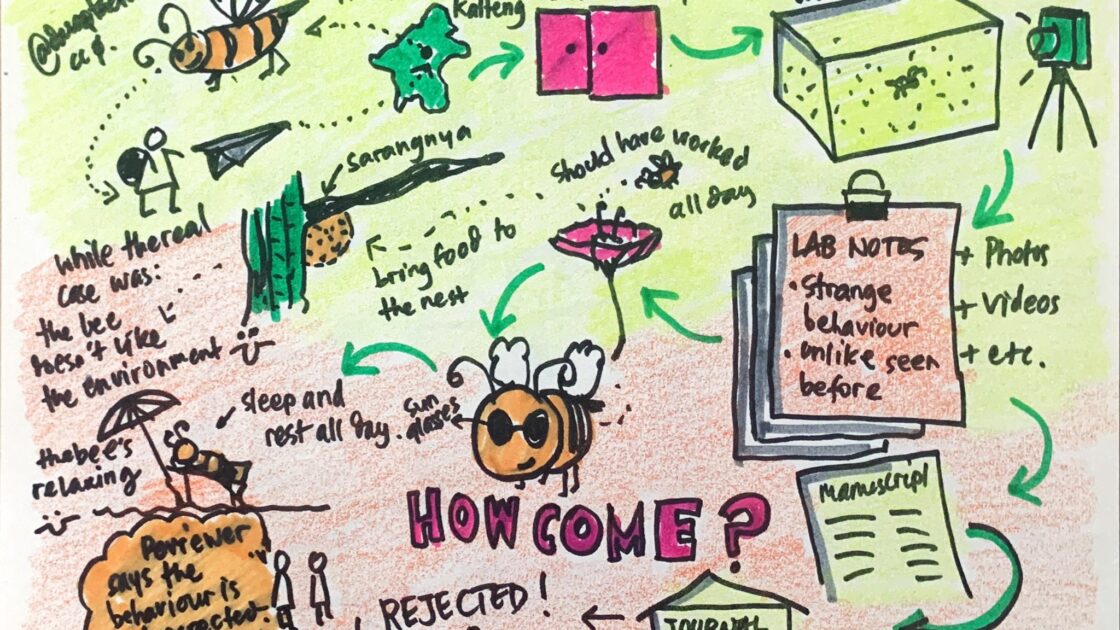
The experiment that was supposed to work The experiment looked straightforward on paper. The protocol was well established, the reagents were fresh…
Beyond the Bench: How Early Career Researchers Expand Their Scientific Identity
The earliest stages of my scientific journey began in a small laboratory in Mumbai, where I learned the precision and patience that molecular work demands. At that time, I believed that scientific identity was built entirely through technical competence. If I could perfect my procedures, sharpen my troubleshooting instincts, and generate clean data, I assumed that I would eventually become the scientist I wanted to be.
A wider view of science
That understanding began to shift when I moved to New York to pursue a Master’s degree in Cell and Molecular Biology at Fordham University. I had been awarded a full scholarship and a graduate assistantship, an opportunity that felt like both an endorsement and an invitation. The support gave me confidence, but it also opened a wider view of what a scientific career could look like.
At Fordham, I discovered that research was only one dimension of scientific life. Equally transformative were the moments when I explained concepts to undergraduates, helped classmates navigate complex ideas, or refined my own understanding by teaching others.
Mentoring taught me that clarity is not an accessory to science. It is inseparable from it. The more I helped others interpret experimental reasoning, the more I understood my own. I began to appreciate that the scientific identity I had imagined was incomplete. It was broader than I realized.
The art of communication
My internship at Imprint Labs pushed this realization further. I worked on cloning strategies, HEK293 transfections, and assay optimization, but the most memorable challenge involved presenting research directions to board members. I learned that the same scientific idea could either confuse or inspire depending on how it was communicated. The experience made me rethink my relationship with data. It was not enough to conduct strong experiments. I had to convey their meaning with precision. It became clear that communication is part of the scientific method, not something appended to it.
My perspective expanded again when I joined Mount Sinai to work in inflammatory skin disease research. Processing real patient derived non invasive samples taught me how deeply human molecular work can be. Each sample carried a fragment of a person’s lived reality. Extracting high quality RNA and proteins for sequencing and proteomic workflows required meticulous technique, but it also required sensitivity. Clinical material does not behave like textbook models. It introduces biological variability, unexpected patterns, and a sense of responsibility that transforms how one approaches the bench.
Writing and reviewing
As my research responsibilities grew, another evolution took place. I began writing. What started as small reflections eventually became a published article in BioSpace about communication as a scientific skill. Writing revealed that science becomes stronger when it is articulated clearly, and that thoughtful explanation is an act of service to both the scientific community and the public. It demanded that I identify the essence of what I wanted to say and express it with purpose.
Around the same time, I became more involved in peer review. I evaluated manuscripts for the Journal of Infection and Public Health, Frontiers in Musculoskeletal Disorders, Advanced Science, and Allergy. Reviewing work spanning musculoskeletal biology, immunology, and clinical research broadened my analytical lens. It sharpened my ability to interpret evidence, evaluate study design, and distinguish meaningful signal from noise. It also deepened my appreciation for scientific integrity. Peer review became a way to strengthen my own thinking through the act of strengthening someone else’s work.
The scientific infrastructure
My scientific world continued to widen when I joined communities such as Sigma Xi, AWIS, and the New York Academy of Sciences. Becoming a full time member of Sigma Xi was particularly meaningful because it connected me with a community of researchers who value rigor, clarity, and scientific responsibility. Through these societies, I discovered how much learning takes place through conversations, panels, advocacy efforts, and shared experiences. Participating in early career initiatives and mentorship programs showed me that community is not an optional component of science. It is part of the infrastructure that sustains scientific progress.
These experiences introduced me to questions that extend far beyond my own experiments. How do we make science more accessible for students who feel intimidated by it? How can communication highlight scientific rigor without diluting complexity? What does ethical, transparent research look like in practice, not just in principle? These questions have shaped me as profoundly as any technical training.
Helping others
Mentoring younger students remains one of the most meaningful dimensions of my journey. Helping someone understand a concept, design an experiment, or build confidence in their scientific abilities has reinforced for me that science grows strongest when knowledge is shared. Mentorship requires intention, empathy, and clarity, all of which translate directly into the way we conduct and communicate research. The process enriches both the mentor and the mentee, creating a cycle of learning that strengthens the culture of science.
Today, when I reflect on my path from Mumbai to New York, from student to researcher, from mentee to mentor, I see that my scientific identity was shaped not only by the experiments I conducted but also by the interactions, writing, reviewing, teaching, and community engagement that surrounded them. Science lives in the laboratory, but it thrives in the spaces where ideas are exchanged, communicated, challenged, and expanded.
For early career researchers, these dimensions are not external to science. They are integral. Communicating clearly, mentoring thoughtfully, participating in professional societies, contributing to peer review, and engaging with interdisciplinary teams all strengthen the foundation on which rigorous research is built. These experiences cultivate skills that are not always visible in a lab notebook, but they influence the quality, direction, and impact of the science that emerges.
A more expansive scientific identity
My view of scientific identity is now more expansive than I ever imagined at the beginning of my journey. It is rooted in curiosity, sustained by community, refined by communication, and strengthened by shared learning. The bench remains central to my work, but everything around it gives that work deeper meaning.
Science, I have learned, is not defined only by the experiments we perform. It is defined by the way we participate in the scientific world. And for early career researchers, that world is rich, dynamic, and full of places to grow.
Image credit: Dasaptaerwin. This file is made available under the Creative Commons CC0 1.0 Universal Public Domain Dedication. Source: Wikimedia Commons