

All good things come to an end. After 404 blog posts, it is time for the PLOS ECR Blog to resign. For…
From Nanocrystals to Stem Cells: What a Winding Path Taught Me About Building a Research Career
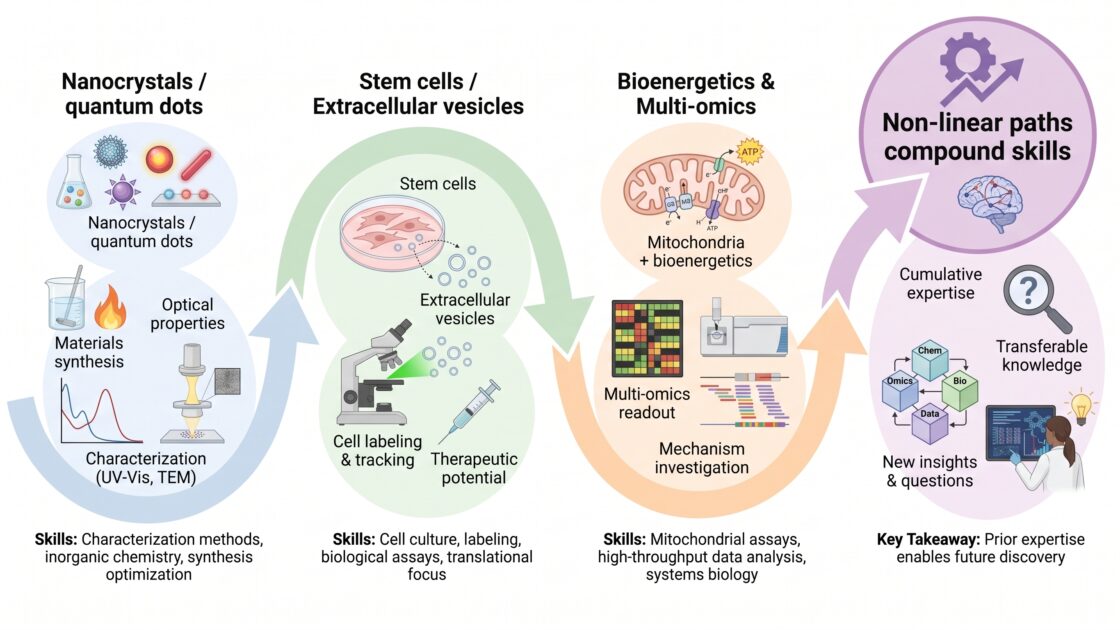
A first-person reflection for the PLOS ECR Community
The career I planned looked nothing like the one I have
If you’d told me during my PhD deep in a microwave reactor, coaxing quantum dots to fluoresce in the near-infrared, that I’d one day spend my days isolating stem cells, measuring how cells breathe, and transplanting pancreatic islets, I wouldn’t have believed you. Those felt like different worlds, different vocabularies, different tribes of scientists who didn’t read each other’s journals.
And yet here I am, and the winding path is the story. So, if you’re an early-career researcher quietly worried that your route hasn’t been linear enough that you’ve drifted between fields, or that a pivot might undo everything you’ve built, this is the post I wish someone had written for me.
Starting where I started: nanomaterials in India
My research life began with materials. As a PhD student in India, funded by national fellowships rather than lab largesse, I designed and synthesized multifunctional quantum-dot nanocarriers, copper indium sulfide, indium phosphide, and all the finicky chemistry that comes with pushing a material to emit light where tissue is most transparent. I doped them with metal ions to make them show up on both MRI and optical imaging, functionalized their surfaces to target cancer cells, and spent long days on UV-Vis, TEM, XRD, and zeta-potential measurements, then checking whether any of it was toxic in zebrafish embryos.
It was demanding, unglamorous, and often disheartening; most syntheses failed before one worked. But it taught me the single most transferable skill I own: how to characterize something rigorously and refuse to trust a result until the data forces you to. I didn’t know it then, but I wasn’t just learning nanochemistry. I was learning how to be a scientist.
Living on fellowship funding taught me something else, too: that resourcefulness, begging time on shared instruments, squeezing full experiments out of half the reagents is itself a research skill. It’s a lesson that never left me.
The first pivot that scared me
The move from nanomaterials into regenerative medicine into mesenchymal stem cells, extracellular vesicles, and islet biology didn’t happen in a clean, planned step. It felt, honestly, like starting over. New literature I hadn’t read, new techniques I’d never touched, colleagues fluent in a biology I was only beginning to learn. There’s a specific kind of impostor feeling that comes with being the most experienced person in the room about your old field and the least experienced about the new one. I felt it constantly.
What I didn’t appreciate at the time and what I’d tell any ECR facing a similar leap is that your old field comes with you. My imaging background didn’t become irrelevant; it became my edge. When I moved into stem-cell work, I could think about how to label and track cells in a living animal, how to watch a therapy actually work over time rather than guessing from a single endpoint. I helped build a platform to follow stem cells restoring liver function after injury, imaging the recovery longitudinally rather than at one frozen moment. A “materials person” turned out to have something a pure biologist might not: a native instinct for seeing the invisible. The pivot wasn’t a reset. It was a compounding.
The second pivot: learning to ask how cells actually work
Then came a subtler shift, one that reshaped how I think about therapy itself. Working with stem cells and their extracellular vesicles, I kept running into the same question: why does one batch of cells heal and another doesn’t? The answer, it turned out, lived deeper than the imaging could reach in the cell’s energy machinery, its mitochondria, its bioenergetic state.
So I learned a third language. I moved into measuring how cells breathe and generate energy, into mitochondrial function and transfer, and into reading cells at the level of their transcriptomes and proteomes, layering multi-omics data on top of the imaging and the biology to build a fuller picture of why a therapy works, not just whether it does. This was the moment the whole path finally made sense to me. The materials scientist who learned to see cells had become someone who could also listen to what those cells were doing internally and then connect the two. None of it was planned. Each pivot simply asked a question that the previous field couldn’t answer, and I followed it.
What the winding path actually gave me
Looking back across the projects, quantum dots, then MSCs from different tissue sources, then extracellular vesicles, then the bioenergetics and multi-omics that tie it all together, then pancreatic islets and their stubborn survival problems, the through line isn’t a single technique. It’s a way of working that only a non-linear path could have produced:
- I ask “how do we measure this?” before “what do we expect?” a habit forged in materials characterization that turns out to be just as vital when you’re assessing whether a batch of cells is genuinely potent.
- I’m comfortable being a beginner. Having done it more than once voluntarily, terrifyingly, I know the discomfort is temporary, and the reward is a broader map.
- I translate between worlds. Sitting between materials science, cell biology, and bioenergetics, I’m often the one who can explain a nanoparticle to a biologist, a viability assay to a chemist, and an omics dataset to both. That translation work is quietly some of the most valuable I do.
None of this was in a career plan. All of it came from the detours.
The parts nobody puts on a CV
A CV is a highlight reel. It lists the papers and the fellowships; it says nothing about the stretches where almost nothing worked, the experiments abandoned, the manuscript that came back savaged, the mornings I genuinely wondered whether I’d chosen the wrong life. Every ECR reading this has their own version of that hidden CV, and I think we do each other a disservice by hiding it. So, let me say the unglamorous truth plainly. Reinventing yourself scientifically is slow. You will feel behind your peers who stayed in one lane. The productivity that eventually shows up on paper is almost always downstream of a long, invisible period where you were simply learning badly, publicly, and without much to show for it. That period isn’t wasted. It’s the foundation. It just doesn’t photograph well.
On community because none of this is solo
The other thing a linear-career narrative erases is people. I have never done meaningful science alone. Each pivot was survivable only because generous collaborators let me be the novice in the room and answered my basic questions without making me feel small. Later, some of the work I’m proudest of came from partnerships that crossed disciplines and, increasingly, borders, collaborators across institutions and time zones, some of whom I’ve worked closely with for years.
If there’s one investment I’d urge every early-career researcher to make, it’s this: be generous first. Answer the junior person’s question. Share the protocol before you’re asked. The network you build that way is worth more than any single grant.
What I’d tell you if we were having coffee
If you’re an ECR feeling the specific anxiety of a non-linear path, here’s what I’d want you to hold onto:
- Your detours are assets, not liabilities. The combination of fields you carry is rarer and more valuable than any single deep specialism.
- Being a beginner again is a strength you can practice. Every time you do it, it gets less frightening, and your map gets bigger.
- Judge yourself on trajectory, not on a snapshot. The quiet learning years are doing more than they appear to.
- Build your people early and generously. Careers are made of collaborators, not just publications.
- Do the boring, invisible work well. It’s what lets your work outlive the moment, and lets others build on it.
The path isn’t finished
I still don’t have a tidy story with a clean arc. I have a set of detours that, looked at from far enough away, turned into a direction. That’s what a research career actually is for most of us, not a straight line drawn in advance, but a path you understand only by looking back at it. So, if your route has been strange, if you’ve changed fields or felt like you were starting over, take heart. The winding path isn’t a detour from the career. Very often, it is the career, and usually a more interesting one than the straight line you thought you were supposed to walk.
Featured image is made in BioRender software.